Ads 468x60px

Showing posts with label social network technology. Show all posts

Wednesday, September 12, 2012

Facebook works to remove fake accounts from its network


Facebook is the largest social networking website with more than 800 million users worldwide. In spite of such huge numbers, the fact is a lot of Facebook accounts are fake. Official figures from Facebook say as many as 8.7 per cent or 83 million accounts on the network are bogus. About 4.8 percent of them are duplicate, 2.4 percent are user-misclassified accounts and 1.5 percent are “undesirable” accounts.

According to Facebook India business manager Pavan Varma, the social networking website is making “huge efforts” to reduce these numbers and prevent misuse of such identities. The official further reveals in case a dubious account is found, Facebook will ask the user to provide his/her identification details. Accounts that use a generic name instead of a proper name, use images of celebrities/cartoon characters as profile image, or do not have “enough friends,” may come under the Facebook scanner, says Varma.

"It could even be that Facebook comes back to you saying, could you help us identify yourself if you don't have enough friends, because we don't want fake identities. We are worried about the experience we deliver...It's not about protecting our brand identity so much," he said.

The Facebook official also acknowledged malware and other methods were used to create fake accounts and Likes. Varma further said advertisers should not only focus on numbers.  "How does an advertiser today treat a Facebook page? It is treated as a place where they just come with a number of people who are there. But that is a wrong way of doing it," he stressed.

It's notable the social networking website has put in place several ways to ensure it only has authentic users. Facebook allows users to verify their phone numbers and also report accounts that seem bogus. To know more about how to report a violation, visit Facebook Help Center.  

Sunday, August 19, 2012

News for Twitter’s API changes have users fuming...


San Fransisco: In a move to regulate how users access its microblogging service, Twitter announced new restrictions that sternly discouraged independent software developers from creating Twitter apps.

While the move is not expected to immediately affect how current Twitter users across the world access the service, the new rules will likely nudge new users toward Twitter’s own apps while slowly ushering the demise of popular third-party clients like Tweetbot.

Twitter, which has been seeking greater control of its platform as it looks to grow into a digital media powerhouse sustained by advertising revenues, has deeply divided Silicon Valley’s tech circles with its strategy.

No longer just a 140-character, text messaging service, Twitter believes it can provide more interactive content — and better serve ads and measure their performance — if the vast majority of its users use officially sanctioned programs to log into Twitter. But that approach has riled many software developers as well as users, many of whom favour independent clients like Hootsuite, Uber and Tweetbot over Twitter’s own products.

Under its new rules, independent software developers who create new Twitter apps will only be allowed to have a maximum of 100,000 users. Existing apps with more than 100,000 users can double their user base before Twitter imposes a hard cap on user base.
The new guidelines, which were published on Twitter’s blog on Thursday, attracted a torrent of criticism from “power-users” and software developers.

But they did not come as a surprise to many of the company’s observers. Last month, Twitter signaled its intentions to clamp down on its platform when it ended a syndication deal to show tweets within LinkedIn’s website.

Tuesday, August 14, 2012

Google Unveils Search Changes to Curb Access to Pirated Content


Google Inc. (GOOG) said it will introduce changes to its search engine that will discourage piracy by placing legitimate copyrighted content higher in online queries.

The company next week will begin using algorithms that push potentially pirated material to a lower position in search results, Mountain View, California-based Google said today in a blog posting on its website.

Entertainment companies have been pressing Google for years to take steps to make pirated content harder to find. The new system will use “removal notices,” or complaints from entertainment companies, that a website has received in ranking search results, Amit Singhal, senior vice president for engineering, said on the blog. Hollywood applauded the move.

“We are optimistic that Google’s actions will help steer consumers to the myriad legitimate ways for them to access movies and TV shows online,” Michael O’Leary, a senior executive vice president at the Motion Picture Association of America, said in an e-mailed statement.

Lower rankings don’t represent a conclusion that a copyright has actually been violated, Singhal wrote. The company received 4.3 million copyright removal notices in the last 30 days, he said.

“So while this new signal will influence the ranking of some search results, we won’t be removing any pages from search results unless we receive a valid copyright removal notice from the rights owner,” Singhal said.

Jason Freidenfelds, a Google spokesman, didn’t immediately return a call seeking additional comment.

Google was little changed at $642 at the close in New York. The stock has declined less than 1 percent this year.

Friday, August 10, 2012

Latest addition to Google search results: Your emails from Gmail


San Fransisco: Google is creating an information bridge between its influential Internet search engine and its widely used Gmail service in its latest attempt to deliver more personal responses more quickly.

The experimental feature unveiled Wednesday will enable Google’s search engine to mine the correspondence stored within a user’s Gmail account for any data tied to a search request. For example, a query containing the word “Amazon” would pull emails with shipping information sent by the online retailer.

Such Gmail results will typically be shown to the right of the main results, though in some instances, the top of the search page will highlight an answer extracted directly from an email. For example, the request “my flight” will show specific airline information imported from Gmail. Something similar could eventually happen when searching for a restaurant reservation or tickets to a concert.

Although Google has a commanding lead in Internet search, it remains worried about the threat posed by social networking services such as Facebook Inc. As social networks have made it easier to share information online, the Web is starting to revolve more around people than the keywords and links that Google’s search engine.

Google has been trying to adapt by building more personal services and plugging them into its search engine.

Blending email information into general search results could raise privacy worries. Google is trying to mitigate that by showing Gmail results in a collapsed format that users must open to see the details. For now, users must sign up to participate.

Sunday, July 22, 2012

YouTube launches Face Blur to help keep activists anonymous


Video website YouTube unveiled on Wednesday a way for users to automatically blur human faces in videos they upload, a feature that would help protect the identities of political dissidents, YouTube parent Google Inc said.

Once known more as a repository for fuzzy, home-made cat videos, YouTube has become a growing destination for slick, highly produced entertainment and serious news content. Earlier this week, a study by the Pew Research Center's Project for Excellence in Journalism said amateur "citizen journalism" footage from events such as the 2011 tsunami in Japan were some of the most-watched clips on YouTube.

In recent months YouTube has hosted dozens of videos from the rebellion in Syria, often uploaded by rebels seeking to publicize their struggle. But the videos have also revealed the identity of rebel fighters.

"Whether you want to share sensitive protest footage without exposing the faces of the activists involved, or share the winning point in your 8-year-old's basketball game without broadcasting the children's faces to the world, our face blurring technology is a first step towards providing visual anonymity for video on YouTube," YouTube said in a blog post Wednesday.

The feature also allows for the original copy of the uploaded video to be deleted. Videos may also be kept private.

"YouTube is proud to be a destination where people worldwide come to share their stories, including activists," YouTube said.

Wednesday, July 11, 2012

Facebook and Twitter feed anxiety and study finds....


Social networking sites such as Facebook and Twitter feed anxiety and make people feel inadequate, a study has found.

A poll of those using the technology found more than half of those surveyed said the sites had changed their behaviour - and half of those said their lives had been altered for the worse.

Most commonly, those who suffered a negative impact from social media said their confidence fell after comparing their own achievements to those of friends online.

Two-thirds said they found it hard to relax completely or to sleep after spending time on the sites.

And one quarter of those polled said they had been left facing difficulties in their relationships or workplace after becoming confrontational online.

In total, 298 people were polled by Salford Business School at the University of Salford, for the charity Anxiety UK.

Of those, 53 per cent said the launch of social networking sites had changed their behaviour - and of those, 51 per cent said the impact had been negative.

The research also demonstrated the addictive powers of internet, with 55 per cent of people saying they felt "worried or uncomfortable" when they could not access their Facebook or email accounts.

More than 60 per cent of people said they felt compelled to turn off electronic gadgets in order to have a break, with one in three of those surveyed saying they switched the devices off several times each day.

The findings about behaviour changes after using social networking sites came from smaller in-depth research which was then carried out by Anxiety UK.

Nicky Lidbetter, the charity's chief executive said: "If you are predisposed to anxiety it seems that the pressures from technology act as a tipping point, making people feel more insecure and more overwhelmed."

She said the charity was surprised by the high proportion of people who found that the only way to ensure a break from the demands of their devices was to switch them off, as they were not capable of simply ignoring their mobile phones, BlackBerry devices and computers.

Dr Linda Blair, a clinical psychologist said many people suffered increased anxiety because they failed to take charge of the demands being placed on them.

She said: "I think one of the key things is that people have begun to behave as though technology is in control of them, instead of the other way round. We can switch the gadgets off but a lot of us have forgotten how to".

Last year, a global study found that turning off mobile phones, avoiding the internet and tuning out of the television and radio can leave people suffering from symptoms similar to those seen in drug addicts trying to go "cold turkey".

Scientists asked volunteers from 12 universities around the world to stay away from computers, mobile phones, iPods, television and radio for 24 hours.

They found that the participants began to develop symptoms typically seen in smokers attempting to give up. The majority of those who enrolled in the study failed to last the full 24 hours without demanding their gadgets back.

Friday, June 29, 2012

Facebook to launch 'Find Friends Nearby' feature


WASHINGTON: Social networking giant Facebook is testing a new feature that would allow users to connect more easily by logging on to a page on the site that shows people nearby.

Ryan Patterson, the Facebook engineer who built the feature, named 'Find Friends Nearby' told TechCrunch that he and a colleague wanted to make it easier to connect with people you have just met.

"I built Find Friends Nearby with another engineer for a hackathon project. For me, the ideal use case for this product is the one where when you're out with a group of people whom you've recently met and want to stay in contact with," the Telegraph quoted Patterson, as saying.

"Facebook search might be effective, or sharing your vanity addresses or business cards, but this tool provides a really easy way to exchange contact information with multiple people with minimal friction," he added.

The feature does not show all of your friends who are nearby.

Only those who have the page open are listed, meaning that attendees at a conference, for example, could connect to each other quickly by all visiting the page.

To access the service one has to log on to the page, give Facebook permission to use your location and wait for the search to determine who else is nearby.

It is, however, unclear how close somebody has to be to count as 'nearby'.

Wednesday, June 27, 2012

Facebook draws users anger with email switch


MENLO PARK, CALIFORNIA: Facebook has changed your email address. That's how it appears after a quiet change in the way the company displays users' contact information.

Facebook replaced the email address users chose when they signed up with a facebook.com address. The Facebook email accounts allow users to communicate with outside email addresses via Facebook.

The changes were first pointed out by bloggers over the weekend, leading to complaints from users.

An email message to Facebook representatives seeking an explanation was not immediately returned.

The company said in a statement in April that it was ``updating addresses on Facebook to make them consistent across our site.''

Users are free to restore their former email addresses.


Monday, June 25, 2012

Facebook to allow users to pay in local currencies soon...


Facebook will soon allow users worldwide to pay in their local currencies for various paid applications and games on the popular social networking site, a move that would help it in diversifying revenue streams.

"...We are updating our payments product to support pricing in local currency (ex: US dollar, British pound and Japanese yen) instead of Credits," Facebook said on its website.

"By supporting pricing in local currency, we hope to simplify the purchase experience, give you more flexibility, and make it easier to reach a global audience of Facebook users who want a way to pay for your apps and games in their local currency," it added.

In 2009, Facebook, introduced a payment system 'Facebook Credits' or a virtual currency was mainly used to buy virtual goods in games like FarmVille. Last year, 15 million users bought virtual goods on the site using its payments service.

"We will release local currency support for in-app payments in the next few months. Any apps or games that sell virtual items will be required to use local currency by the end of the year," the company said.

Friday, June 8, 2012

Google acquires Quickoffice mobile app


Google on Tuesday announced that it has acquired mobile office software company Quickoffice. "Quickoffice has an established track record of enabling seamless interoperability with popular file formats, and we'll be working on bringing their powerful technology to our Apps product suite,"
said Google in its official blog.

Details of the acquisition were not disclosed, Xinhua reported.

Launched in 1997, Quickoffice provides mobile office document software for devices running Apple's iOS and Google's Android operating systems, allowing users to open, view and edit Microsoft Office files with complete document data integrity.

The company said its product has been downloaded on 300 million devices so far in 180 countries.

Analysts said Google may release its own mobile office software suite as Microsoft appears to hold back Office from other mobile platforms, rather than its Windows 8.

Quickoffice is Google's second major acquisition this week. On Monday, the search giant announced that it had purchased the instant messaging firm Meebo.

According to an earlier report by technology news site AllThingsD, the price Google paid for Meebo is about $100 million.

Wednesday, June 6, 2012

Congressmen voice concerns about Facebook plans to let children join site


WASHINGTON –  Two congressmen voiced concerns Monday following a Wall Street Journal report that Facebook was exploring ways to let kids join the social network without lying about their age.

Massachusetts Democrat Ed Markey and Texas Republican Joe Barton fired off a letter to Facebook boss Mark Zuckerberg with 14 paragraphs' worth of questions about technology the network is developing to give kids their own accounts.

"We acknowledge that more and more children under the age of 13 are using Facebook, and this is a problem that needs to be addressed," they wrote.

"However, we believe strongly that children and their personal information should not be viewed as a commodity to be bought and sold to the highest bidder."

The Wall Street Journal reported late Sunday that Facebook is developing technology that would allow children younger than 13 years old to use the site under parental supervision.

Sources said mechanisms being tested include connecting children's accounts to their parents' and controls that would allow adults to decide who their kids can "friend" and what applications they can use.

The under-13 features could enable Facebook and its partners to charge parents for games and other entertainment accessed by their children.

Any attempt to give younger kids access to the site would be extraordinarily sensitive, given regulators' already heightened concerns about how Facebook protects user privacy.

Monday, June 4, 2012

Google to build new web addresses including '.lol'


Google has said it plans to run an array of new top-level domains, including ".google", ".youtube" and ".docs", as part of a major expansion of the web's addressing system.

The search giant would also run ".lol", a top-level domain that would refer to the common online abbreviation for "laugh out loud", as the firm thought that ".lol" had "interesting and creative potential".

According to The Telegraph, Google had kept its plans secret in an attempt to avoid rival bids until Thursday, when the deadline for applications passed.

In total Google has made more than 50 applications to Icann, which is the closest organisation to a governing body for the internet, for new alternatives to ".com" or ".co.uk".

It signaled to the fact that Google could offer each YouTube channel its own simple address. For instance, the current www.youtube.com/joebloggs could become www.joebloggs.youtube.

Vint Cerf, one of the inventors of the internet, who now works for Google, said that an expanded addressing system could make it easier for web users to find things online.

"By opening up more choices for Internet domain names, we hope people will find options for more diverse and perhaps shorter - signposts in cyberspace," he wrote on the firm's blog.

The full list of almost 2,000 applications is due to be published on 13 June, because of a delay caused by a technical glitch in the application system.

Tuesday, May 29, 2012

Facebook hiring Apple engineers to work on smartphones - report ..........


Adding to the recent rumours of a Facebook phone, The New York Times is reporting that the social giant, which recently went public, is expanding its efforts to create a smartphone. This is not the first time that we are hearing such rumours. Both TechCrunch and AllThingsD have reported in the past that Facebook is building a smartphone, even if the company was working, the handset never made it to the market.

Fresh from its IPO, Facebook is reportedly exploring more opportunities to earn revenue and making smartphones is one of these. According to NY Times sources, most of whom include Facebook employees and several engineers sought by Facebook recruiters, the social giant has hired more than half a dozen Apple engineers who worked on the iPhone and iPad.

These engineers have joined the company's already existing mobile team, which is working on a smartphone, code named Buffy. The device which is based on a modified version of Android, was first revealed by tech blog AllThingsD last year.

With mobile being the biggest growth area right now, Facebook seeks to extend its mobile presence going beyond apps. "Mark is worried that if he doesn't create a mobile phone in the near future that Facebook will simply become an app on other mobile platforms," a Facebook employee told NY Times.

Saturday, May 26, 2012

Yahoo seeks to shake up search, Web browsing


Joining the battle to redefine Internet search, Yahoo is taking aim with a new browser enhancement it calls "Axis."

It alters browsers made by other companies to display search results in a more convenient and visual format.

The troubled Internet company Yahoo Inc. released Axis in Apple's app store late Wednesday. That version will work only on Apple's iPhone, iPad and iPod Touch. The software also can be installed as a plug-in on most major browsers used on desktop computers and laptops. Apps for other mobile devices are in the works.

A device running Axis can display search results in a panorama of visual thumbnails that can be scrolled through above a Web page. It's a departure from search engines' traditional presentation of a list of staid Web links that require more navigation and guesswork.

"Searching through links has outlived its utility," said Shashi Seth, a Yahoo Inc. senior vice president. "Users are demanding more now because we are all short on time."

All the major search engines are adopting new formats intended to make it easier for users to find information without clicking through to page after page.

Two weeks ago, Microsoft Corp. previewed an upcoming change that will spread Bing's search results in three columns, including one devoted to personalized recommendations pulled from Facebook, Twitter and other social networking services.

Last week, Google unveiled a new search feature called a "Knowledge Graph" that seeks to provide more immediate answers by highlighting information from a database containing more than 500 million entries about people, places and other commonly requested things.

The biggest challenge facing Axis may be overcoming the perception that Yahoo stopped innovating in search when it joined forces with Microsoft and started relying on Bing.

"If it's good enough and cool enough, people will go out of their way to get it," predicted IDC analyst Karsten Weide.

Yahoo is counting on Axis to reverse its steadily declining share of the Internet's lucrative search market and bring it more traffic from among the growing number of smartphone and tablet users.

Its greatest appeal figures to be on mobile devices because users with the app installed can see their search results at the top of the screen just by flicking on whatever page is displayed. The relevant results appear in a ribbon of Web page snapshots, making it easier for users to find the right information.

Much like Google's Knowledge Graph, Axis draws its results from a custom-built index. Most of the data in the Axis index resides on Yahoo's own services. If Axis can't find answers there, it presents links from Bing's search index.

Yahoo has relied on Bing's technology since 2010 as part of a decade-long partnership formed to lure users away from Google. So far, most of Bing's gains have come at Yahoo's expense, but Yahoo was losing search traffic well before it began leaning on Bing.

Yahoo's share of the U.S. search market stood at 13.5 percent through April, down from nearly 25 percent five years ago, according to the research firm comScore Inc. Bing holds a 15.4 percent share, up from 9.4 percent five years ago when Microsoft operated a search engine under a different name and system. Google's share has climbed from 56 percent five years ago to more than 66 percent now.

Yahoo's alliance with Microsoft gives it the flexibility to offer unique search features, such as Axis, that Bing doesn't have. Getting people to use its search engine more frequently is important to Yahoo because it keeps 88 percent of the revenue generated from requests made on its service, but none when a query is entered directly on Bing.

The erosion in Yahoo's Internet market share has been a major factor in a financial malaise that has caused the company's stock to slump for years and contributed to the management turmoil that has taken Yahoo through four CEOs -- including two interim leaders -- during just the past nine months, when it was working on Axis.

Thursday, May 24, 2012

Google officially acquires Motorola Mobility.......!


After waiting months for the go-ahead to say so, Google CEO Larry Page today announced that his company now officially owns Motorola Mobility.

Google announced plans to acquire Motorola Mobility for $12.5 billion in August. Upon doing so, the companies had to clear regulatory hurdles to get the deal done. Regulators in both the U.S. and the European Union approved the acquisition back in February, but the companies were forced to wait for China. Over the weekend, China approved the deal, paving the way for Google to close it.

As part of the acquisition, Page announced today that Motorola Mobility chief Sanjay Jha has stepped down from his post. In his place, Google has named "long-time Googler" Dennis Woodside to be the mobile firm's new chief executive.

"I've known Dennis for nearly a decade, and he's been phenomenal at building teams and delivering on some of Google's biggest bets," Page wrote in the blog post. "One of his first jobs at Google was to put on his backpack and build our businesses across the Middle East, Africa, Eastern Europe and Russia. More recently he helped increase our revenue in the U.S. from US$10.8 billion to US$17.5 billion in under three years as President of the Americas region."

It has been widely believed that the main reason Google acquired Motorola Mobility was for its patents. The search company and its vendor partners are currently waging legal battles around the world with a host of companies over claims that Android violates patents. Motorola Mobility holds thousands of patents and patent applications that could come in handy for any future legal proceedings.

For Motorola Mobility, the deal made perfect financial sense. The company is not the leading Android vendor, and has faced some trouble competing against Apple. When Google came along with a US$40-per-share offer, representing a 63 percent premium on its share price at the time of the deal, it just made sense.

Google has made it clear that Motorola will operate independently from its own operation, and the search giant/Android maker will not show any favoritism. However, according to reports, China was not so convinced of that, and forced Google to agree to keep Android open and free for a period of five years to ensure it didn't change its stance and give Motorola preferential treatment.

Still, Motorola's competitors haven't expressed any displeasure with the deal. In fact, J.K. Shin, Samsung's mobile head, said back in August that he was pleased with the acquisition, and believed that it "demonstrates Google's deep commitment to defending Android, its partners, and the ecosystem".

But what about Motorola employees? TechCrunch reported yesterday, citing sources, that Google is planning to launch a "listening tour" at Motorola to see what the mobile company's employees actually do. Based on that information, the company could decide to lay off some Motorola employees. Although TechCrunch didn't say how many employees might be terminated, its sources said that the layoffs could come down "imminently".

Google declined CNET's request for comment on the matter, and Page made no indication in his blog post whether layoffs would be coming. Instead, he touted Motorola's success over the last several decades.

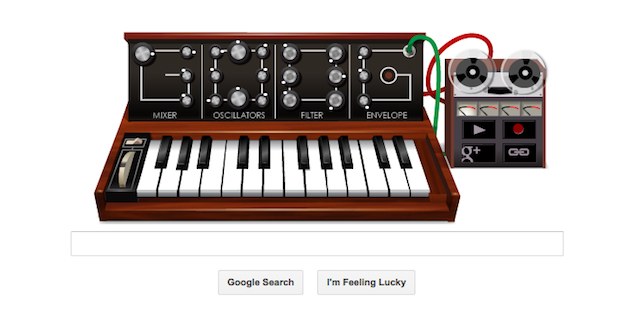
Bob Moog gets a musical tribute by Google doodle

Google has come out with another interactive doodle to celebrate the 78th birthday of Robert Arthur "Bob" Moog. The doodle consists of playable recordable Moog synthesizer.

Users can create music by clicking the keys of this virtual synthesizer with their mouse/touchpad or via the number keys. There's an option to fiddle around with various settings of this keyboard in order to get the best audio output. If that was not enough, the doodle also offers users the option to record their musical creations and play them back. If you are happy with what you hear and want to share with friends, then Google gives an option to share the recorded compositions through Google+.

This is not the first time that Google has come out with a playable doodle. It had done that on June 9, 2011 to celebrate the 96th birthday of Les Paul, a famous American guitarist and song writer, who has a guitar famously named after him.

Coming back to today's doodle, Robert Moog is best known for his invention of the Moog Synthesizer. It was one of the first electronic instruments that allowed musicians to mimic any musical instrument, voices or natural sounds by flipping a switch or twisting a dial.

Tuesday, May 22, 2012

Facebook set to lift ban on under-13s joining


Facebook looks set to relax a ban on children using its site in a move that could see millions more sign up.

A senior employee of the company said the decision to lift the restriction could come about after admitting a large number of under 13-year-olds join up anyway.

The announcement follows Facebook's floatation on the stock market for a price of $38 a share - a valuation that puts the company's worth at over $100billion.


Friday, May 18, 2012

Google Revamps Search, Creates Knowledge Graph :-

The new feature is designed to make it easier for users to find what they're looking for and to offer additional related information.

Google on May 16 began rolling out the latest generation of its dominant search engine, introducing what officials are calling the Knowledge Graph.

The Knowledge Graph is designed to offer users an improved search experience by not only doing a better job of finding exactly what they are searching for, but also by then presenting the users with more information related to their searches. If a user searches for Leonardo da Vinci, they not only will get information about him, but information about his paintings and other works, and information about other Renaissance figures.

“The Knowledge Graph enables you to search for things, people or places that Google knows about—landmarks, celebrities, cities, sports teams, buildings, geographical features, movies, celestial objects, works of art and more—and instantly get information that’s relevant to your query,” Amit Singhal, senior vice president of engineering at Google, said in a May 16 post on the search giant’s blog. “This is a critical first step toward building the next generation of search, which taps into the collective intelligence of the Web and understands the world a bit more like people do.”

Google’s unveiling of Knowledge Graph comes at a time when there is a lot of focus on the Web 2.0 market. Microsoft on May 11 rolled out a revamp of its own Bing search engine, which included the ability to feature social results from Facebook and Twitter in searches. Microsoft also made changes to Bing designed to make it easier to use.

Google continues to be the dominant search engine, with 66.5 percent of search results in April, according to numbers compiled by comScore. Microsoft’s Bing was a distant second, at 15.4 percent, with Yahoo in third at 13.5 percent.

Google’s move also comes the same week that social networking giant Facebook, a growing rival of Google’s for Internet ads, launches its initial public offering (IPO) of stock, an event that could shoot the company’s value to close to $100 billion. The Knowledge Graph, which reportedly has been talked about in the industry for months, could be seen by some as a way for Google to remind the industry that despite the hype around the Facebook IPO, it is still a significant innovator.

According to Singhal, Google is leveraging a database of more than 500 million objects, and more than 3.5 billion facts not only about those objects, but also the relationship between them. Google engineers have gone back and looked at what users have searched for and what they have been asking about for each item. “For example, people are interested in knowing what books Charles Dickens wrote, whereas they’re less interested in what books Frank Lloyd Wright wrote, and more in what buildings he designed,” he wrote.

Google search users in the United States should start seeing the Knowledge Graph in their searches over the next few days, according to Google officials. When they start their search by entering a query, the Knowledge Graph for their query will show up to the right of the search results. One example Google used was of the name “Taj Mahal,” which could refer to the ancient temple in India, the blues singer or the casino in New Jersey.

Once Google determines which Taj Mahal is being searched for—for example, the musician—the Knowledge Graph will list various other relevant topics, possibly from albums Taj Mahal has released to other singers in the same musical genre. Click on one of those singers, and related information to that person is then displayed.

“We’ve always believed that the perfect search engine should understand exactly what you mean and give you back exactly what you want,” Singhal wr,,ote. “And we can now sometimes help answer your next question before you’ve asked it, because the facts we show are informed by what other people have searched for. For example, the information we show for Tom Cruise answers 37 percent of next queries that people ask about him.”

It’s also a natural evolution for the company, according to Johanna Wright, product management director at Google.

“We’re in the early phase of moving from being an information engine to becoming a knowledge engine,” Wright said in a video about the Knowledge Graph.

Google reportedly was able to leverage the technology it inherited in 2010 when it bought Metaweb, which had developed a knowledge base, dubbed Freebase, in developing Knowledge Graph.

Tuesday, May 15, 2012

Google Doodle Hugs Itself for Mother's Day :-

If you haven't yet called your parents for Mother's Day – and we apologize in advance if that's not an option for your particular situation – Google's doing its part to tug on your heartstrings should you try to search for things on the Web today.

That's right – it's time for a new Google doodle.

Blink and you'll miss the short animation, which starts off with a pearl necklace-wearing "Mama g" waiting around an empty room. The door slowly cracks open and in run her two "o" children – we'll call them "Red" and "Yellow." They tackle her with flying hugs (or try to, at least), and give her a pretty purple flower to commemorate the day.

As the little Google letter family stand there, either hand-in-hand or with their little letter arms around each other, the rest of the Google logo fades in. No coloration or normal font faces this time: The focus of the scene remains on mom and kids when the animation officially ends.

Cute and simple – or so you might think. In actuality, the time, effort, and animation required to build the Doodle aren't the only complexities surrounding Mother's Day drawings. Namely, Mother's Day isn't a universally agreed-upon holiday.

Monday, May 14, 2012

Microsoft Bing goes social in search war with Google :-

Computerworld - Microsoft's move to boost Bing's social networking feaures could finally give it an opportunity to truly take on Google's dominant search engine, analysts say.

The updated Bing search engine, unveiled on Thursday, can now include the user comments, likes and activities posted in popular social networks like Facebook and Twitter.

Patrick Moorhead, an analyst at Moor Insights & Strategy, agreed with Microsoft's contention that the redesign is "the most significant since Microsoft launched Bing three years ago."

"The Bing redesign really is a search revolution and the biggest change I have seen from them in years," Moorhead said.

"Bing could revolutionize social search by tapping into Facebook's and Twitter's capabilities. Unlike Google, Bing and Microsoft aren't vying to create their own social media destination, so they can access the best-of-breed social media sites like Facebook and Twitter," Moorhead added.

Bing's new interface, which is expected to move from a private to a public beta test period soon, offers users a sidebar that focuses on people in the user's social networks and their opinions and search queries, Microsoft said.

For instance, a user might search for a local bike shop. Along with the usual search results, there will be a "people you know who may know" social sidebar that offers up bike shops that friends have "liked" or commented on.

The social sidebar also is designed to let users ask their friends questions about their query topic, and those friends can respond either through Bing or Facebook, Microsoft said.

"Contrary to their history of unnecessarily overcomplicating software, Microsoft has shown a knack with Bing for boiling down functionality to a useful level," said Brad Shimmin, an analyst at CurrentAnalysis. "I think if anything, it will entice consumers to try Microsoft Bing."

Since Microsoft first launched Bing in the summer of 2009, the company faced a daunting task in taking on Google's dominant search engine.

And Google has remained dominant. Despite all of Microsoft's efforts, including an upgrade in 2011, Bing simply hasn't been able to take a significant bite out of Google's market share.

Now, Microsoft is hoping that its social search capabilities can become the game-changer the company needs in the battle against Google.