


Tuesday, May 8, 2012

Saturday, May 5, 2012
LG announces Optimus L7 with Android 4.0 ICS
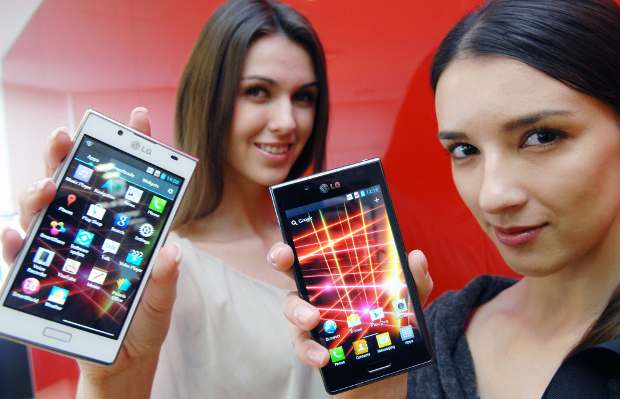
Mere 8.7 mm thin Optimus L7 will run single core 1 GHz Qualcomm processor and will feature 4.3-inch touchscreen display.
LG has announced a new Android 4.0 Ice Cream Sandwich running smartphone. Called as Optimus L7, this new smartphone comes with L-Style designing and will be made available in major markets in Europe and Asia starting today. However, LG has not confirmed its availability in India as of now.
The Mobile Indian had earlier reported about the LG's launch of new L-Style bearing Optimus smartphone line up - L3, L5 and L7. Out of these three devices, the Optimus L7 is the flagship LG device that is set to arrive with 4.3-inch display.
LG noted that the Optimus L7 will come with Android 4.0.3 Ice Cream Sandwich update by default. That indeed is good news for those who are looking forward to an Android 4.0 ICS device. Targeted at the fashion conscious folks, the L7 will come with an 8-megapixel camera with LED Flash at the back. There will be a 1.3 megapixel front facing camera for video chat and clicking images.
With mere 8.7 mm slim body, the new LG Optimus L7 features 4.3-inch touchscreen display that supports WVGA (480x800) pixel resolution. This smartphone will house a single-core 1 GHz Qualcomm Snapdragon MSM7227A mobile processor coupled with age old Adreno 200 graphics chip. LG has provided 1 GB RAM and offered 4 GB onboard storage out of which only 2.8 GB is user accessible.
Apart from that, the LG Optimus L7 will also come with Near Field Communication chip built-in and will feature DLNA (Digital Living Network Alliance) support. This means L7 can detect and engage in data exchange with select NFC tags and can wirelessly stream multimedia contents to DLNA certified devices. This smartphone also features Bluetooth 3.0, WiFi and GPS sensors.
At this moment, the price of Optimus L7 is unknown.
LG has announced a new Android 4.0 Ice Cream Sandwich running smartphone. Called as Optimus L7, this new smartphone comes with L-Style designing and will be made available in major markets in Europe and Asia starting today. However, LG has not confirmed its availability in India as of now.
The Mobile Indian had earlier reported about the LG's launch of new L-Style bearing Optimus smartphone line up - L3, L5 and L7. Out of these three devices, the Optimus L7 is the flagship LG device that is set to arrive with 4.3-inch display.
LG noted that the Optimus L7 will come with Android 4.0.3 Ice Cream Sandwich update by default. That indeed is good news for those who are looking forward to an Android 4.0 ICS device. Targeted at the fashion conscious folks, the L7 will come with an 8-megapixel camera with LED Flash at the back. There will be a 1.3 megapixel front facing camera for video chat and clicking images.
With mere 8.7 mm slim body, the new LG Optimus L7 features 4.3-inch touchscreen display that supports WVGA (480x800) pixel resolution. This smartphone will house a single-core 1 GHz Qualcomm Snapdragon MSM7227A mobile processor coupled with age old Adreno 200 graphics chip. LG has provided 1 GB RAM and offered 4 GB onboard storage out of which only 2.8 GB is user accessible.
Apart from that, the LG Optimus L7 will also come with Near Field Communication chip built-in and will feature DLNA (Digital Living Network Alliance) support. This means L7 can detect and engage in data exchange with select NFC tags and can wirelessly stream multimedia contents to DLNA certified devices. This smartphone also features Bluetooth 3.0, WiFi and GPS sensors.
At this moment, the price of Optimus L7 is unknown.
Samsung Galaxy S3: the latest bid to dominate the Android market
Samsung Galaxy S3: the latest bid to dominate the Android market:-
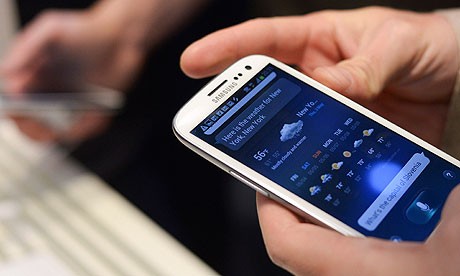
Samsung has released a new flagship smartphone, the Galaxy S3,
including voice control, wireless beaming of content and exclusive apps,
as it aims to consolidate its position at the top of the mobile sector.
The
S3 has a super AMOLED 4.8in screen, larger than its predecessor the S2,
with an 8 megapixel rear camera and 1.9MP front camera which offers
"intelligent camera features" that the company says will adapt to what
it sees you doing.
The phone runs on Google's Android 4.0 (Ice
Cream Sandwich) software, but has a number of Samsung additions –
including voice recognition and eye tracking.
The phone will go
on sale on 30 May in the UK, with Orange and Phones4U already lined up
to sell it. No price has yet been given. It will go on sale in the US
this summer. Samsung said it will go on sale with 296 carriers in 145
countries. It can connect at "4G" speeds in compatible countries.
"S
Voice" can respond to spoken orders such as "wake up" when its screen
is off, "snooze" for an alarm, or to play a particular song, change
volume settings, and take pictures. It also responds to gestures, so
that lifting the phone to the face while sending a text message will
dial the recipient's number instead.
Samsung has also souped up
Google's Android Beam (which can pass data such as business card
details) so it is capable of sending a 1GB file between two S3 phones in
three minutes, or a 10MB file in two seconds by touching them together.
It
comes in a 15GB or 32GB version, though the company said a 64GB model
would come soon. Buyers can get an optional wireless charging pad,
similar to that offered with the now-defunct HP TouchPad last year.
At
4.8in, the screen size is only just below the minimum 5in that most
analysts class as a tablet – indicating Samsung's confidence that
top-end users will want larger screens. The first-generation Galaxy S in
2010 had a 4in screen; the S2, a 4.3in screen.
The company sold
an estimated 44m smartphones across its entire portfolio in the first
quarter of 2012, more than any other company. It dominates the Android
sector too, selling around 50% of phones on a platform which itself
makes up 50% of smartphone sales.
Jason Jenkins, editor of CNET
UK, said: "The Samsung Galaxy S3 is a cracker of a smartphone that makes
the iPhone look a little like yesterday's model. It cements Samsung's
place as one of the leading phone manufacturers and really puts the
pressure on Apple to come up with something different for its next
iPhone later in the year.
"It's also starting to look like this
will be a two-horse race – Samsung and Apple fighting it out for the
number one spot with everyone else left to pick up the crumbs. HTC,
Sony, BlackBerry and Nokia are the ones with the real work to do."
Ian
Fogg, an analyst at IHS Suppli, said: "What's striking is that Samsung
is focusing on software and the experiences, more than the hardware
(although that is excellent too). Features like Pop over, social tag,
and S Voice all aspire to differentiate from the opposition through the
user experience that Samsung's software customisation delivers.
"Samsung
have been leading up to this for a while, but this is the first time
they've led their product positioning on user experience and software."
Francisco
Jeronimo, IDC's smartphones analyst, was downbeat, saying: "It is not
an eye-catching device that will overwhelm consumers."
He noted
that analysts had not been given the chance to try out the voice control
in pre-release demonstrations of the phone. Of a brief test, he said:
"Overall, [it] seems very similar to Siri, but my first impression was
that is not as well integrated with the phone as Siri is with the
iPhone."
Carolina Milanesi, smartphones analyst at the research
group Gartner, said that Samsung was looking for ways to remain ahead of
rivals in the Android space, as well as Apple.
"They need to
push the boundaries in order to remain ahead," she said. "It will be
interesting to see how many of these new features [in the S3] will be
open to developers so that they can take advantage of them in their
apps."
However, if developers start to target Samsung APIs for
apps, that could potentially split the Android platform still further
beyond the individual versions produced by Google – and would also tend
to increase Samsung's control of Android.
Such an "embrace and
extend" manoeuvre would build its control of the platform, where it
already presently has half of worldwide sales and is the biggest
profit-maker.
Jeronimo observed: "Samsung definitely embraced
Android, and is extending it. We shouldn't also forget that Samsung has a
quite opportunistic approach to market trends.
"If Android is
now the new kid on the block that can best contribute to its success,
they will invest and nurture it to maximise the opportunity. But if the
trend changes (and they are very good at anticipating that), they will
also change the platform they embrace in the future."
Famous Scientist (John Ericsson)
-: John Ericsson :-
 |
| (John Ericsson) |
John Ericsson (July 31, 1803 – March 8, 1889) was a Swedish-American
inventor and mechanical engineer, as was his brother Nils Ericson. He
was born at Långbanshyttan in Värmland, Sweden, but primarily came to be
active in England and the United States. He is remembered best for
designing the steam locomotive Novelty (in partnership with engineer
John Braithwaite) and the ironclad USS Monitor.
John's and Nils's father Olaf Ericsson who worked as the supervisor for a mine in Värmland had lost money in speculations and had to move his family from Värmland to Forsvik in 1810. There he worked as a 'director of blastings' during the excavation of the Swedish Göta Canal. The extraordinary skills of the two brothers were discovered by Baltzar von Platen, the architect of the Göta Canal. The two brothers were dubbed cadets of mechanics of the Swedish Royal Navy and engaged as trainees at the canal enterprise. At the age of fourteen, John was already working independently as a surveyor. His assistant had to carry a footstool for him to reach the instruments during surveying work.
At the age of seventeen he joined the Swedish army in Jämtland, serving in the Jämtland Field Ranger Regiment, as a Second Lieutenant, but was soon promoted to Lieutenant. He was sent to northern Sweden to do surveying, and in his spare time he constructed a heat engine which used the fumes from the fire instead of steam as a propellant. His skill and interest in mechanics made him resign from the army and move to England in 1826. However his heat engine was not a success, as his prototype was designed to burn birchwood and would not work well with coal (the main fuel used in England).
German drawing (1833) of steam locomotive "Wilhelm IV" with scale in feet, built by "Braithwaite und Ericsson".
Notwithstanding the disappointment, he invented several other mechanisms instead based on steam, improving the heating process by adding fans to increase oxygen supply to the fire bed. In 1829 he and John Braithwaite built "Novelty" for the Rainhill Trials arranged by the Liverpool and Manchester Railway. It proved considerably faster than the other entrants but suffered recurring boiler problems, and the competition was won by English engineers George and Robert Stephenson with Rocket.
Two further engines were built by Braithwaite and Ericsson, named William IV and Queen Adelaide after the new king and queen. These were generally larger and more robust than Novelty and differed in several details (for example it is thought that a different design of blower was used which was an ‘Induced Draught’ type, sucking the gases from the fire). The pair ran trials on the Liverpool and Manchester Railway but the railway declined to purchase the new designs.
He then improved the ship design with two screw-propellers moving in different directions (as opposed to earlier tests with this technology, which used a single screw). However, the Admiralty disapproved of the invention, which led to the fortunate contact with the encouraging American captain Robert Stockton who had Ericsson design a propeller steamer for him and told him to bring his invention to the United States of America, as it would supposedly be more welcomed in that place. As a result, Ericsson moved to New York in 1839.
John's and Nils's father Olaf Ericsson who worked as the supervisor for a mine in Värmland had lost money in speculations and had to move his family from Värmland to Forsvik in 1810. There he worked as a 'director of blastings' during the excavation of the Swedish Göta Canal. The extraordinary skills of the two brothers were discovered by Baltzar von Platen, the architect of the Göta Canal. The two brothers were dubbed cadets of mechanics of the Swedish Royal Navy and engaged as trainees at the canal enterprise. At the age of fourteen, John was already working independently as a surveyor. His assistant had to carry a footstool for him to reach the instruments during surveying work.
At the age of seventeen he joined the Swedish army in Jämtland, serving in the Jämtland Field Ranger Regiment, as a Second Lieutenant, but was soon promoted to Lieutenant. He was sent to northern Sweden to do surveying, and in his spare time he constructed a heat engine which used the fumes from the fire instead of steam as a propellant. His skill and interest in mechanics made him resign from the army and move to England in 1826. However his heat engine was not a success, as his prototype was designed to burn birchwood and would not work well with coal (the main fuel used in England).
German drawing (1833) of steam locomotive "Wilhelm IV" with scale in feet, built by "Braithwaite und Ericsson".
Notwithstanding the disappointment, he invented several other mechanisms instead based on steam, improving the heating process by adding fans to increase oxygen supply to the fire bed. In 1829 he and John Braithwaite built "Novelty" for the Rainhill Trials arranged by the Liverpool and Manchester Railway. It proved considerably faster than the other entrants but suffered recurring boiler problems, and the competition was won by English engineers George and Robert Stephenson with Rocket.
Two further engines were built by Braithwaite and Ericsson, named William IV and Queen Adelaide after the new king and queen. These were generally larger and more robust than Novelty and differed in several details (for example it is thought that a different design of blower was used which was an ‘Induced Draught’ type, sucking the gases from the fire). The pair ran trials on the Liverpool and Manchester Railway but the railway declined to purchase the new designs.
He then improved the ship design with two screw-propellers moving in different directions (as opposed to earlier tests with this technology, which used a single screw). However, the Admiralty disapproved of the invention, which led to the fortunate contact with the encouraging American captain Robert Stockton who had Ericsson design a propeller steamer for him and told him to bring his invention to the United States of America, as it would supposedly be more welcomed in that place. As a result, Ericsson moved to New York in 1839.
Tuesday, May 1, 2012
What Google Drive offers and how it stacks up against the competition

Rumours of Google coming up with their own cloud storage service
started as far back as 2006. Now that it has been officially announced,
ET takes a quick look what it offers and how it stacks up against the
competition
WHAT IS GOOGLE DRIVE?
Google Drive is the name for Google's new cloud-based storage service. It includes 5GB of free space while paid plans start as low as US$ 2.49 (Rs 130) per month for an additional 25GB. If you are already a paid subscriber of a Google storage plan for Gmail or Picasa, you automatically get 25GB on Google Drive instead of 5GB.
Like most cloud services, Drive offers Windows and Max OS X apps as well as mobile apps for Android devices (iOS support is expected soon). Drive will play a vital role in Google's Chrome OS operating system in the near future.
Like any other cloud storage service, you can use Google Drive to store and sync files across various devices. Not only can you store files safely, you can even open/view various supported files (HD videos, Photoshop image files, Illustrator design files and so on) within Drive's user interface in any modern browser.
Google has also incorporated optical character recognition in Drive - you can upload images/documents and use Drive to recognise objects or extract text. And since it works across Google services, you can upload files directly from one to other.
What makes Google Drive stand out is the fact it's not just a simple cloud storage service. Google leveraged their existing Google Docs platform for Google Drive - making it an always-accessible , document editing and cloud service.
Drive also tracks changes done to documents and keep revision copies of up to 30 days - you can choose to restore any version of the edited document if required. Google Drive is the only service that offers extensive file format support for viewing within its interface. And finally, Drive will soon integrate with all other Google products.
WHAT IS GOOGLE DRIVE?
Google Drive is the name for Google's new cloud-based storage service. It includes 5GB of free space while paid plans start as low as US$ 2.49 (Rs 130) per month for an additional 25GB. If you are already a paid subscriber of a Google storage plan for Gmail or Picasa, you automatically get 25GB on Google Drive instead of 5GB.
Like most cloud services, Drive offers Windows and Max OS X apps as well as mobile apps for Android devices (iOS support is expected soon). Drive will play a vital role in Google's Chrome OS operating system in the near future.
Like any other cloud storage service, you can use Google Drive to store and sync files across various devices. Not only can you store files safely, you can even open/view various supported files (HD videos, Photoshop image files, Illustrator design files and so on) within Drive's user interface in any modern browser.
Google has also incorporated optical character recognition in Drive - you can upload images/documents and use Drive to recognise objects or extract text. And since it works across Google services, you can upload files directly from one to other.
What makes Google Drive stand out is the fact it's not just a simple cloud storage service. Google leveraged their existing Google Docs platform for Google Drive - making it an always-accessible , document editing and cloud service.
Drive also tracks changes done to documents and keep revision copies of up to 30 days - you can choose to restore any version of the edited document if required. Google Drive is the only service that offers extensive file format support for viewing within its interface. And finally, Drive will soon integrate with all other Google products.
There will be no new phones announced at BlackBerry World

Eager to see Research In Motion's latest and greatest phones at BlackBerry World next week? Prepare to be disappointed.
RIM will be taking a software-heavy approach this year, using the event to formally unveil its BlackBerry 10 operating system.
"We are not unveiling any BlackBerry 10 hardware," a company representative confirmed to CNET.
There's never been a more crucial BlackBerry World than this next event. The annual confab is a chance for BlackBerry developers, product enthusiasts, and business partners to take in RIM's latest and future wares. This year, RIM has the added task of convincing its shrinking band of supporters that the company is still worth taking a chance on amid declining market share and the notion that it is too far gone to be saved.
Its single hope: the BlackBerry 10 platform build on QNX, which also powers its PlayBook software. The platform represents a break from its older--almost archaic--BlackBerry operating system and is the company's best hope at mounting a comeback. CEO Thorsten Heins sees it more than simple software for phones; he said during the last quarterly conference call that he believes multiple devices beyond phones will emerge from BlackBerry 10.
His strategy isn't unique; Google's Android and Apple's iOS both power multiple types of mobile devices, while Microsoft's Windows 8 will be extended to PCs, laptops, and tablets.
RIM will make its case that it too should be included in the conversation next week at BlackBerry World in Orlando, Fla. The company plans to launch a beta version of its BlackBerry 10 toolkit. Developers in attendance will also be getting a Dev Alpha device, according to a RIM representative. The device, however, isn't a BlackBerry 10 phone, nor will it be running the software.
The event will also likely be a showcase for the apps that are currently being developed for BlackBerry 10. A few developers will be showing off demonstrations of what they are building for BlackBerry 10.
Still, the lack of hardware has to be disappointing to some BlackBerry fans who were expecting a strong showing at the event. Last year, RIM used the conference to debut its BlackBerry Bold 9900, its flagship phone last year. The phone marked the first device to use its BlackBerry 7 operating system, which was an update of its older platform.
RIM has maintained that it plans to launch the first BlackBerry 10 phone in the second half, with some speculation that it may emerge in August and hit stores in October.
RIM will be taking a software-heavy approach this year, using the event to formally unveil its BlackBerry 10 operating system.
"We are not unveiling any BlackBerry 10 hardware," a company representative confirmed to CNET.
There's never been a more crucial BlackBerry World than this next event. The annual confab is a chance for BlackBerry developers, product enthusiasts, and business partners to take in RIM's latest and future wares. This year, RIM has the added task of convincing its shrinking band of supporters that the company is still worth taking a chance on amid declining market share and the notion that it is too far gone to be saved.
Its single hope: the BlackBerry 10 platform build on QNX, which also powers its PlayBook software. The platform represents a break from its older--almost archaic--BlackBerry operating system and is the company's best hope at mounting a comeback. CEO Thorsten Heins sees it more than simple software for phones; he said during the last quarterly conference call that he believes multiple devices beyond phones will emerge from BlackBerry 10.
His strategy isn't unique; Google's Android and Apple's iOS both power multiple types of mobile devices, while Microsoft's Windows 8 will be extended to PCs, laptops, and tablets.
RIM will make its case that it too should be included in the conversation next week at BlackBerry World in Orlando, Fla. The company plans to launch a beta version of its BlackBerry 10 toolkit. Developers in attendance will also be getting a Dev Alpha device, according to a RIM representative. The device, however, isn't a BlackBerry 10 phone, nor will it be running the software.
The event will also likely be a showcase for the apps that are currently being developed for BlackBerry 10. A few developers will be showing off demonstrations of what they are building for BlackBerry 10.
Still, the lack of hardware has to be disappointing to some BlackBerry fans who were expecting a strong showing at the event. Last year, RIM used the conference to debut its BlackBerry Bold 9900, its flagship phone last year. The phone marked the first device to use its BlackBerry 7 operating system, which was an update of its older platform.
RIM has maintained that it plans to launch the first BlackBerry 10 phone in the second half, with some speculation that it may emerge in August and hit stores in October.
Svante Arrhenius
-: Svante Arrhenius :-
 |
Svante Arrhenius
|
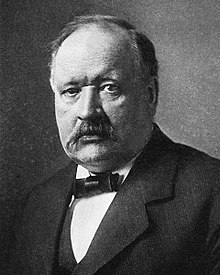
Svante August Arrhenius (19 February 1859 – 2 October 1927) was a
Swedish scientist, originally a physicist, but often referred to as a
chemist, and one of the founders of the science of physical chemistry.
He received the Nobel Prize for Chemistry in 1903. The Arrhenius
equation, lunar crater Arrhenius and the Arrhenius Labs at Stockholm
University are named after him.
Arrhenius was born on February 19, 1859 at Vik (also spelled Wik or Wijk), near Uppsala, Sweden, the son of Svante Gustav and Carolina Thunberg Arrhenius. His father had been a land surveyor for Uppsala University, moving up to a supervisory position. At the age of three, Arrhenius taught himself to read without the encouragement of his parents, and by watching his father's addition of numbers in his account books, became an arithmetical prodigy. In later life, Arrhenius enjoyed using masses of data to discover mathematical relationships and laws.
At age 8, he entered the local cathedral school, starting in the fifth grade, distinguishing himself in physics and mathematics, and graduating as the youngest and most able student in 1876.
Arrhenius next received a travel grant from the Swedish Academy of Sciences, which enabled him to study with Ostwald in Riga (now in Latvia), with Friedrich Kohlrausch in Würzburg, Germany, with Ludwig Boltzmann in Graz, Austria, and with van 't Hoff in Amsterdam.
In 1889 Arrhenius explained the fact that most reactions require added heat energy to proceed by formulating the concept of activation energy, an energy barrier that must be overcome before two molecules will react. The Arrhenius equation gives the quantitative basis of the relationship between the activation energy and the rate at which a reaction proceeds.
In 1891 he became a lecturer at the Stockholm University College (Stockholms Högskola, now Stockholm University), being promoted to professor of physics (with much opposition) in 1895, and rector in 1896.
Eventually, Arrhenius' theories became generally accepted and he turned to other scientific topics. In 1902 he began to investigate physiological problems in terms of chemical theory. He determined that reactions in living organisms and in the test tube followed the same laws. In 1904 he delivered at the University of California a course of lectures, the object of which was to illustrate the application of the methods of physical chemistry to the study of the theory of toxins and antitoxins, and which were published in 1907 under the title Immunochemistry.
He also turned his attention to geology (the origin of ice ages), astronomy, physical cosmology, and astrophysics, accounting for the birth of the solar system by interstellar collision.
Svante Arrhenius was one of several leading Swedish scientists actively engaged in the process leading to the creation in 1922 of The State Institute for Racial Biology in Uppsala, Sweden, which had originally been proposed as a Nobel Institute. Arrhenius was a member of the institute's board, as he had been in The Swedish Society for Racial Hygiene (Eugenics), founded in 1909.
Arrhenius was born on February 19, 1859 at Vik (also spelled Wik or Wijk), near Uppsala, Sweden, the son of Svante Gustav and Carolina Thunberg Arrhenius. His father had been a land surveyor for Uppsala University, moving up to a supervisory position. At the age of three, Arrhenius taught himself to read without the encouragement of his parents, and by watching his father's addition of numbers in his account books, became an arithmetical prodigy. In later life, Arrhenius enjoyed using masses of data to discover mathematical relationships and laws.
At age 8, he entered the local cathedral school, starting in the fifth grade, distinguishing himself in physics and mathematics, and graduating as the youngest and most able student in 1876.
Arrhenius next received a travel grant from the Swedish Academy of Sciences, which enabled him to study with Ostwald in Riga (now in Latvia), with Friedrich Kohlrausch in Würzburg, Germany, with Ludwig Boltzmann in Graz, Austria, and with van 't Hoff in Amsterdam.
In 1889 Arrhenius explained the fact that most reactions require added heat energy to proceed by formulating the concept of activation energy, an energy barrier that must be overcome before two molecules will react. The Arrhenius equation gives the quantitative basis of the relationship between the activation energy and the rate at which a reaction proceeds.
In 1891 he became a lecturer at the Stockholm University College (Stockholms Högskola, now Stockholm University), being promoted to professor of physics (with much opposition) in 1895, and rector in 1896.
Eventually, Arrhenius' theories became generally accepted and he turned to other scientific topics. In 1902 he began to investigate physiological problems in terms of chemical theory. He determined that reactions in living organisms and in the test tube followed the same laws. In 1904 he delivered at the University of California a course of lectures, the object of which was to illustrate the application of the methods of physical chemistry to the study of the theory of toxins and antitoxins, and which were published in 1907 under the title Immunochemistry.
He also turned his attention to geology (the origin of ice ages), astronomy, physical cosmology, and astrophysics, accounting for the birth of the solar system by interstellar collision.
Svante Arrhenius was one of several leading Swedish scientists actively engaged in the process leading to the creation in 1922 of The State Institute for Racial Biology in Uppsala, Sweden, which had originally been proposed as a Nobel Institute. Arrhenius was a member of the institute's board, as he had been in The Swedish Society for Racial Hygiene (Eugenics), founded in 1909.
Subscribe to:
Posts (Atom)


