


Samsung has partnered with Visa to promote mobile payment system.
Samsung is now rolling out phones with built in NFC to support this new
easy payment system. Watch the video to see it in action.
Showing posts with label samsung technology. Show all posts
Showing posts with label samsung technology. Show all posts
Thursday, May 24, 2012

Saturday, May 5, 2012
Samsung Galaxy S3: the latest bid to dominate the Android market
Samsung Galaxy S3: the latest bid to dominate the Android market:-
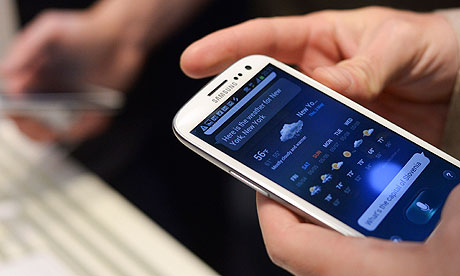
Samsung has released a new flagship smartphone, the Galaxy S3,
including voice control, wireless beaming of content and exclusive apps,
as it aims to consolidate its position at the top of the mobile sector.
The
S3 has a super AMOLED 4.8in screen, larger than its predecessor the S2,
with an 8 megapixel rear camera and 1.9MP front camera which offers
"intelligent camera features" that the company says will adapt to what
it sees you doing.
The phone runs on Google's Android 4.0 (Ice
Cream Sandwich) software, but has a number of Samsung additions –
including voice recognition and eye tracking.
The phone will go
on sale on 30 May in the UK, with Orange and Phones4U already lined up
to sell it. No price has yet been given. It will go on sale in the US
this summer. Samsung said it will go on sale with 296 carriers in 145
countries. It can connect at "4G" speeds in compatible countries.
"S
Voice" can respond to spoken orders such as "wake up" when its screen
is off, "snooze" for an alarm, or to play a particular song, change
volume settings, and take pictures. It also responds to gestures, so
that lifting the phone to the face while sending a text message will
dial the recipient's number instead.
Samsung has also souped up
Google's Android Beam (which can pass data such as business card
details) so it is capable of sending a 1GB file between two S3 phones in
three minutes, or a 10MB file in two seconds by touching them together.
It
comes in a 15GB or 32GB version, though the company said a 64GB model
would come soon. Buyers can get an optional wireless charging pad,
similar to that offered with the now-defunct HP TouchPad last year.
At
4.8in, the screen size is only just below the minimum 5in that most
analysts class as a tablet – indicating Samsung's confidence that
top-end users will want larger screens. The first-generation Galaxy S in
2010 had a 4in screen; the S2, a 4.3in screen.
The company sold
an estimated 44m smartphones across its entire portfolio in the first
quarter of 2012, more than any other company. It dominates the Android
sector too, selling around 50% of phones on a platform which itself
makes up 50% of smartphone sales.
Jason Jenkins, editor of CNET
UK, said: "The Samsung Galaxy S3 is a cracker of a smartphone that makes
the iPhone look a little like yesterday's model. It cements Samsung's
place as one of the leading phone manufacturers and really puts the
pressure on Apple to come up with something different for its next
iPhone later in the year.
"It's also starting to look like this
will be a two-horse race – Samsung and Apple fighting it out for the
number one spot with everyone else left to pick up the crumbs. HTC,
Sony, BlackBerry and Nokia are the ones with the real work to do."
Ian
Fogg, an analyst at IHS Suppli, said: "What's striking is that Samsung
is focusing on software and the experiences, more than the hardware
(although that is excellent too). Features like Pop over, social tag,
and S Voice all aspire to differentiate from the opposition through the
user experience that Samsung's software customisation delivers.
"Samsung
have been leading up to this for a while, but this is the first time
they've led their product positioning on user experience and software."
Francisco
Jeronimo, IDC's smartphones analyst, was downbeat, saying: "It is not
an eye-catching device that will overwhelm consumers."
He noted
that analysts had not been given the chance to try out the voice control
in pre-release demonstrations of the phone. Of a brief test, he said:
"Overall, [it] seems very similar to Siri, but my first impression was
that is not as well integrated with the phone as Siri is with the
iPhone."
Carolina Milanesi, smartphones analyst at the research
group Gartner, said that Samsung was looking for ways to remain ahead of
rivals in the Android space, as well as Apple.
"They need to
push the boundaries in order to remain ahead," she said. "It will be
interesting to see how many of these new features [in the S3] will be
open to developers so that they can take advantage of them in their
apps."
However, if developers start to target Samsung APIs for
apps, that could potentially split the Android platform still further
beyond the individual versions produced by Google – and would also tend
to increase Samsung's control of Android.
Such an "embrace and
extend" manoeuvre would build its control of the platform, where it
already presently has half of worldwide sales and is the biggest
profit-maker.
Jeronimo observed: "Samsung definitely embraced
Android, and is extending it. We shouldn't also forget that Samsung has a
quite opportunistic approach to market trends.
"If Android is
now the new kid on the block that can best contribute to its success,
they will invest and nurture it to maximise the opportunity. But if the
trend changes (and they are very good at anticipating that), they will
also change the platform they embrace in the future."
Monday, April 30, 2012
Samsung's 'vague' manufacturing estimates puts smartphone crown in dispute

‘NEW YORK: Smartphones are the hottest gadgets in the world. But who's the biggest smartphone maker? We don't really know.
Samsung, Apple's chief competitor, gives only vague indications of how many it makes, which means industry watchers come up with widely diverging estimates. Apple Inc. reports its iPhone sales down to the thousands.
In the January to March period, it shipped 35,064,000. South Korea's Samsung Electronics Co. may have sold 32 million, 37.5 million or 44.5 million, depending which analyst you believe. The company itself refuses to say.
What's at stake, of course, are bragging rights. More accurate sales figures from Samsung would also be useful to competitors and to partners like wireless carriers and retailers.
When it reported first-quarter results Friday morning, Samsung said only that overall phone shipments (including ``dumb'' phones) were down more than 10 per cent from the fourth quarter, and that smartphone sales were about the same per centage of the company's overall sales as they have been before.
The problem is that Samsung hasn't reported any hard sales figures in a long time, so analysts are applying these vague hints to their own estimates, which in turn are based on vague hints from previous quarters.
There's even a debate about what Samsung's few guideposts really mean. Jan Dawson, an analyst at Ovum, says the analyst community is split over the interpretation of Samsung's reported ``300 per cent'' increase in smartphone sales in the third quarter of 2011, over the third quarter of 2010. A 300 per cent increase means a quadrupling, but did Samsung really mean that? Or did sales triple, and they made the common mistake of calling that a ``300 per cent increase?''
The two schools of thought account for some of the widely diverging estimates, Dawson believes. Analysts and reporters haven't been able to get Samsung to clarify the issue.
Wayne Lam, an analyst with IHS iSuppli, likens the process of estimating Samsung sales to ``using compasses instead of GPS.'' His estimate for first-quarter smartphone sales is 32 million, which would put Samsung behind Apple.
IDC Corp., a research firm that tracks phone sales, postponed the release of its quarterly phone sales ranking. It was originally scheduled for just after Samsung's report, but analyst Ramon Llamas said ``additional insight'' was needed.
Analysts agree that in terms of overall phone sales, including non-smart ones, Samsung outdid long-time No. 1 Nokia Corp. in the first quarter. But they differ on the margin of victory. Finland's Nokia said it sold 82.7 million phones. ABI Research's Michael Morgan puts Samsung at 83.4 million, only just ahead. Strategy Analytics has it at 93.5 million.
The estimates differ by 10.1 million phones, roughly enough for all the adults in New York, Los Angeles and Chicago.
Samsung is not alone in espousing vagueness. Taiwan-based smartphone maker HTC Corp. recently stopped reporting how many phones it makes, possibly because its sales are in decline.
``The bottom line is Samsung and Apple are definitely consolidating at the top,'' Lam said. ``The lead will trade back and forth a bit.''
Subscribe to:
Posts (Atom)


